Our Alzheimer's story, the beginning
For our Alzheimer's story, I'll start from the beginning. One of the molecules our laboratory studies is called Toll, which sits right at the cell membrane and is involved in immune response in both Drosophila and people. When Toll is over-activated in flies through molecular genetic techniques, such as triggering an upstream activation sequence--or UAS--for it, the result is that the progeny have eyes that are not normal because their development is affected by high Toll expression. Instead of pretty red, symmetrical eyes normally seen in flies, the Toll fly has a rough-eyed phenotype. Here's a picture of the effects of Toll expression, with wild-type, normal eyes on the left and Toll eyes on the right:
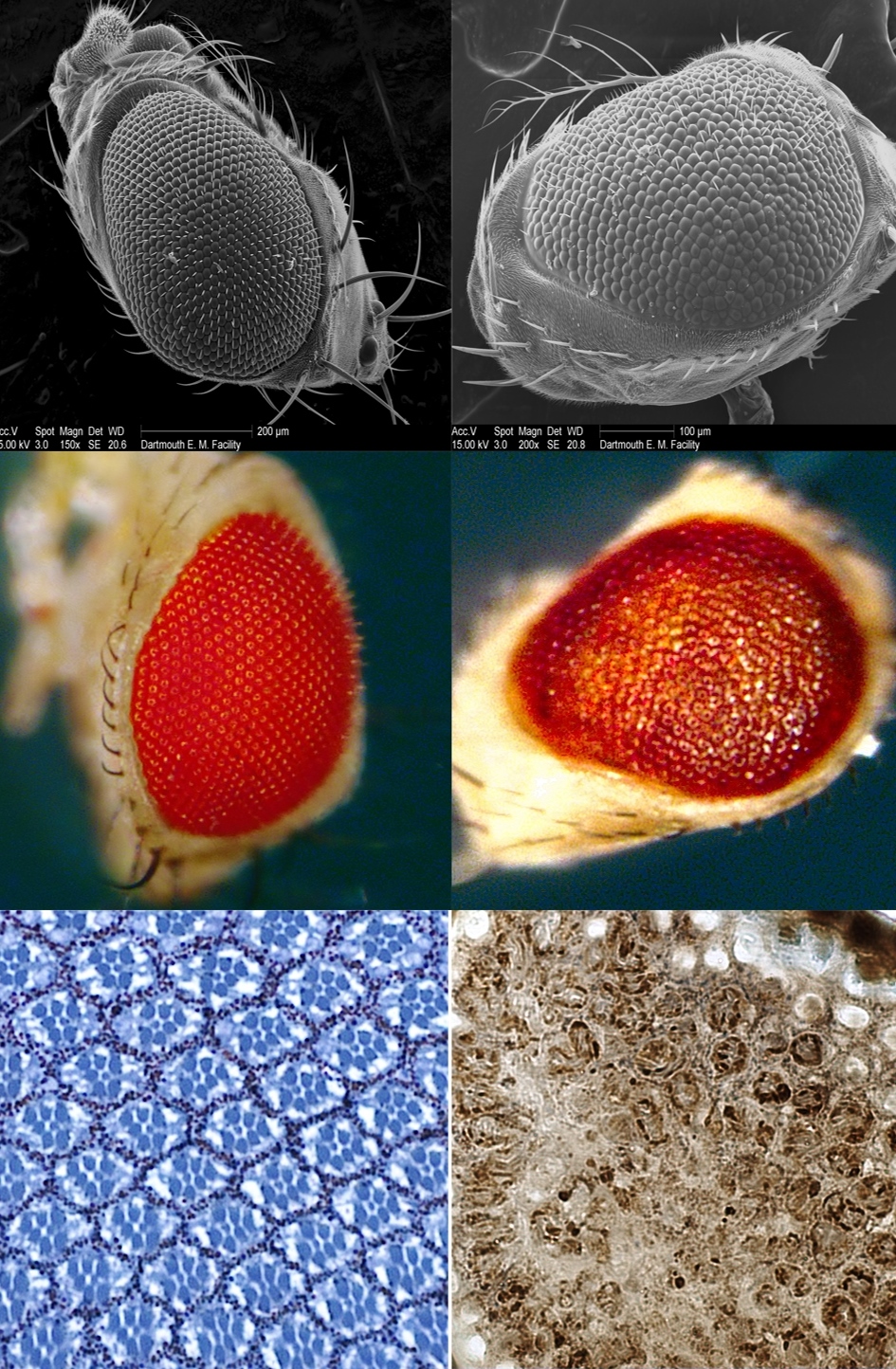
As you can see, the inside of a normal fly eye has a honeycomb-like arrangement called ommatidia, and inside of the ommatidia are flower-like clusters of rhabdomeres, which are the fly's photoreceptors. When Toll is overexpressed, all of these structures break down into eggbeater-like mush. To see what genes might be involved in this pathway of destruction, we collected RNA from both Toll and control flies and had the samples analyzed by microarray. A microarray can read every single gene represented in an RNA sample, so every single gene present in the control RNA could then be compared to the genes present in the Toll RNA sample. We looked for genes whose expression levels went up between the two, because those genes might possibly tell us more about the pathway between healthy cells and degenerating or damaged ones--those displaying "cell death."
Armed with our list of interesting genes, we ordered special flies from a fly warehouse called Bloomington Stocks, which is part of Indiana University. They maintain specialty fly genetic lines called RNAi lines. Each fly line has been specially engineered to express it's specific gene in much lower levels than normal. So if we cross our Toll fly to an RNAi line for a particular gene, the resulting progeny will have a lot less of that gene than had the Toll fly been crossed to a wild-type animal. By working backward, we can see if the gene has any effect on the degeneration we see when over-expressing Toll.
We screened a lot of flies. A LOT. The screen consisted of looking at the progeny of each RNAi cross to see if the eyes looked different. One day I did find a vial with flies whose eyes did not look as messed up as the normal Toll eye. They were flies that had a knockdown of a gene we'll call "C." We fixed some of these eyes in gludaraldehyde and sectioned them on a microtome, and this is what we saw:
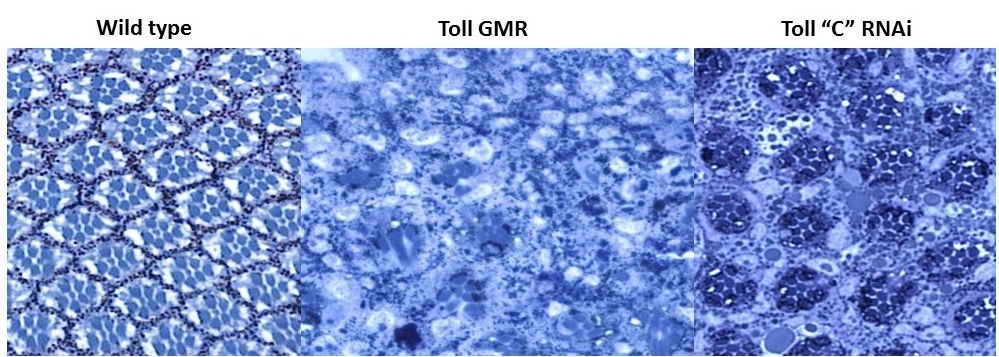
It appeared that our gene of interest, "C", had a significant effect on the degradation of the ommatidia and rhabdomeres, which show a lot more organization. This was a significant find, so we thought about what more we could do with this gene. There happens to be a fly line that expresses A-beta, the protein believed to be involved in Alzheimer's neurodegeneration.
What would happen if we crossed our "C" RNAi flies with the A-beta ones?

0 Comments Add a Comment?